Optional affiliate cookies help us credit the partner who introduced you to Acrelio. Affonso receives referral and device information only after you allow them. If you create a landlord account, we also share an internal account ID to credit later Pro payments. Referral cookies last up to 90 days. Your choice is saved for 180 days.
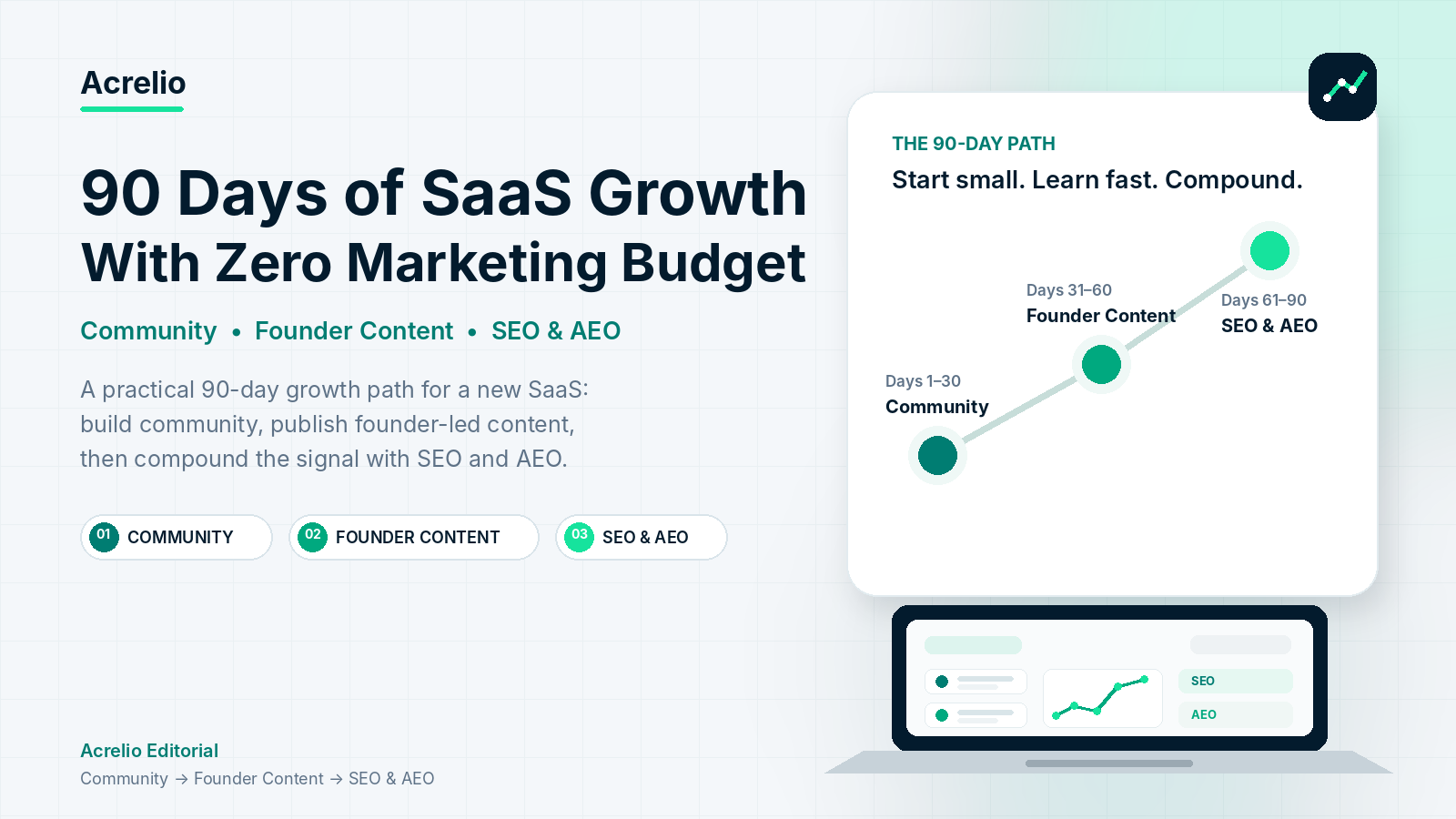
90 Days of SaaS Growth With Zero Marketing Budget: Community, Founder Content, SEO & AEO
A practical 90-day growth system for solo SaaS founders with no ad budget. Learn how to combine community conversations, founder-led content, SEO and AEO to find customers, validate ideas and build distribution that compounds.
Acrelio Editorial··11 min read
If your SaaS has almost no traffic, the most dangerous thing you can do is spend the next three months quietly publishing content and waiting for Google to notice.
Not because SEO doesn't work.
Because a new SaaS has a more urgent problem first: you don't yet know which messages, problems, questions, or channels deserve to be scaled.
You have no established audience. Little or no domain authority. Few backlinks. Almost no branded search. Limited customer data. Probably no advertising budget large enough to buy your way into meaningful experimentation.
So your first 90 days of marketing shouldn't be optimized for maximum traffic.
They should be optimized for maximum learning per founder-hour — while simultaneously building assets that can compound later.
That distinction changes everything.
The zero-budget SaaS marketing strategy I would use is:
Community → Founder Content → SEO/AEO
Not sequentially in the sense that you completely finish one before beginning another. All three start early.
But they do not deserve equal amounts of your time.
The goal is to use community conversations to discover what people actually care about, founder-led content to test and distribute those ideas, and SEO/AEO to turn the winners into durable assets that can continue working long after you publish them.
That's the 90-day system.
Why Most New SaaS Marketing Plans Start in the Wrong Place
A mature company and a brand-new SaaS can follow the same marketing advice and get completely different results.
An established company already has accumulated advantages:
branded searches; backlinks and third-party mentions; existing customers; reviews and testimonials; historical engagement data; email subscribers; social followers; industry relationships; pages Google has crawled for years; and people who already recognize the company name.
A new SaaS starts close to zero on almost every one of those dimensions.
That's the visibility cold start.
And it creates a problem that is easy to misdiagnose.
You publish an article.
Nobody visits it.
90 Days of SaaS Growth With Zero Budget | Acrelio
You publish another five.
Still almost nothing.
The natural conclusion is:
"Our content isn't working."
Maybe.
But it may simply be too early to know.
The product has no distribution system yet. Search engines have limited historical evidence about the domain. Social platforms have limited information about who should see the founder's posts. Potential customers have no reason to search for the brand because they don't know it exists.
That is why the first job isn't "produce more content."
The first job is create feedback loops.
The Three-Layer Zero-Budget SaaS Growth System
Think of early-stage distribution as three layers.
Layer 1: Community creates conversations
Community is where you discover:
What people actually ask.
Not what your keyword tool says they might ask.
Not what another SaaS company's blog says they care about.
Actual questions. Complaints. Workarounds. Objections. Terminology. Competitors. Buying triggers.
This makes existing communities enormously valuable to an early founder.
But here's the counter-intuitive part:
Don't build your own community yet.
If nobody knows your SaaS, launching an empty Discord or Slack community simply gives you another cold-start problem to solve.
Instead, go where your potential customers already spend time.
That might mean Reddit, specialist forums, Slack or Discord groups, Facebook communities, professional associations, niche newsletters, LinkedIn conversations, or industry-specific communities.
An active group containing 500 people who closely match your ideal customer can be far more useful than a giant community containing 50,000 people who never buy what you sell.
The objective isn't to "promote your SaaS."
It's to understand the market well enough that your eventual promotion becomes relevant.
Our underlying research led to the same practical conclusion: community is most useful initially because it supplies customer vocabulary, objections, competitor references, feature priorities, questions and direct conversations.
Layer 2: Founder content creates familiarity
Once conversations start generating useful observations, founder-led content becomes much easier.
You no longer have to sit in front of LinkedIn asking:
"What should I post today?"
You already know.
Someone asked a good question yesterday.
A potential customer challenged one of your assumptions.
Three different people described the same problem differently.
You discovered an unexpected workaround.
A product decision turned out to be harder than expected.
Something you built failed.
Something customers ignored surprised you.
Something small worked much better than expected.
That's content.
And unlike generic "5 lessons from building a startup" material, it comes from experience.
The original research behind this strategy favors customer observations, operational data, before-and-after workflows, real screenshots, mini case studies, lessons learned and evidence-supported opinions over generic motivational content.
There is evidence that substantive thought leadership can influence B2B discovery. In the 2024 Edelman-LinkedIn study of nearly 3,500 management-level professionals, more than 75% of decision-makers and C-suite respondents reported that a piece of thought leadership had prompted them to research a product or service they had not previously considered. The study was conducted with LinkedIn, so it has an obvious platform interest and should be interpreted accordingly, but the result supports the broader value of useful expertise over straightforward product promotion.
The lesson isn't "become an influencer."
It's:
Become recognizably useful to a narrow audience.
Layer 3: SEO and AEO create compounding assets
Community conversations disappear down feeds.
LinkedIn posts eventually lose distribution.
Your website is different.
A strong article, comparison page, calculator, template, guide, dataset, or free tool can continue being discovered months or years later.
That's why SEO starts immediately — but isn't expected to carry the company immediately.
And increasingly, those owned assets can be discovered through more than traditional Google results.
They may appear in:
Google Search, Google AI Overviews, AI Mode, ChatGPT Search, Perplexity, Copilot and other retrieval systems.
That is where AEO — Answer Engine Optimization — enters the picture.
But there's an important warning.
AEO Is Not a Replacement for SEO
AEO has attracted exactly the kind of hype that appears whenever a new distribution system emerges.
You will encounter advice telling you to completely rewrite your website for AI, produce hundreds of tiny answer fragments, create special AI files, target every possible prompt variation, or abandon traditional SEO.
Be skeptical.
Google's current guidance is unusually explicit: the fundamental SEO practices used for normal Search continue to apply to AI Overviews and AI Mode. Google says there are no additional technical requirements and no special schema required simply to appear in those AI experiences.
Google's 2026 generative-AI optimization guidance goes even further. It warns against creating large volumes of pages for query variations merely to manipulate traditional or generative search results and recommends unique, expert-led, non-commodity content instead.
That is good news for a small SaaS.
You don't need a separate "SEO content machine" and "AEO content machine."
You need better source material.
Content containing:
real experience, original observations, explicit answers, evidence, useful examples, clear structure, current information and something another website cannot reproduce by asking an AI to summarize the first ten Google results.
OpenAI takes a similarly straightforward approach to website discovery. Its publisher documentation says public sites can appear in ChatGPT Search, and that publishers wanting their content included in summaries and citations should allow OAI-SearchBot. OpenAI also adds utm_source=chatgpt.com to referral links, giving publishers a way to identify inbound ChatGPT search traffic.
So AEO matters.
But the foundation remains good web publishing.
Why You Shouldn't Bet Everything on Google Traffic
Search is still enormously valuable.
But informational search behavior is changing.
Pew Research Center analyzed browsing behavior from 900 U.S. adults in March 2025. When a Google AI summary appeared, users clicked a traditional search result in 8% of visits, compared with 15% of visits when no AI summary appeared.
That doesn't mean SEO is dead.
It means rankings and traffic are no longer interchangeable concepts.
A page can influence a buying journey without generating the click patterns publishers became accustomed to during the traditional ten-blue-links era.
At the same time, AI systems are creating additional routes through which a company can be discovered.
The rational response for a small SaaS isn't to abandon Google.
It's to avoid having one company, one algorithm, or one channel determine whether your company gets discovered.
Community, founder-led distribution, traditional search, AI search, referrals, product-led tools and direct brand demand should eventually reinforce one another.
The 90-Day Allocation
A solo founder can't operate five full marketing departments.
So the allocation needs to change as evidence accumulates.
During the first month, learning is more valuable than scale.
By month three, you should know enough about the problems and language that resonate to invest more heavily in assets designed to compound.
That allocation comes directly from the 90-day hypothesis we developed: community carries the highest share at the beginning, while SEO/AEO gradually takes a larger share once the founder has actual market signal.
Days 1-30: Find the Conversations
Your first month has one central objective:
Stop guessing what your market cares about.
Identify three to five places where your ideal customers already discuss the problem your SaaS addresses.
Do not enter with a link.
Read.
Observe.
Answer.
Keep a running document of recurring language and questions.
For each useful conversation, capture:
the exact question; the words the person used; the underlying problem; what they have already tried; objections to existing products; competitor names; what triggered the problem now; and whether solving it appears urgent or merely interesting.
These notes eventually become a better editorial calendar than most keyword generators can produce for an unknown startup.
Publish, but don't overproduce
During this first month, publish approximately two founder posts each week.
You don't need daily content.
Buffer's observational analysis of more than two million LinkedIn posts across more than 94,000 accounts found that moving from one weekly post to the 2-5 posts/week range was associated with better average reach and engagement. Buffer sells social publishing software, so treat this as useful platform data rather than proof that posting frequency itself causes SaaS revenue.
For a solo founder, two strong posts per week is enough to test whether ideas resonate without allowing LinkedIn to become a second full-time job.
Meanwhile, publish one substantial owned resource per week if you can maintain quality.
That might be an article.
But don't assume every resource must be a blog post.
It could be a:
calculator, checklist, template, teardown, comparison, benchmark, glossary, workflow, free utility, or research summary.
Useful assets frequently create stronger reasons to link, cite and return than another generic article.
Days 31-60: Concentrate on What Is Working
By the second month, you should start killing weak assumptions.
Maybe Reddit produces thoughtful discussions while LinkedIn produces almost nothing.
Maybe LinkedIn attracts partners while communities generate customer questions.
Maybe your best article isn't your broad "ultimate guide" but a narrow page answering a painful operational question.
Follow the evidence.
This is where many content plans fail.
They treat the editorial calendar as a commitment instead of a hypothesis.
You decided in January to publish Article #14 in March, so Article #14 gets published regardless of whether anyone cares.
Don't do that.
A content roadmap is a queue of experiments, not a sacred document.
At Acrelio, we're using six-article checkpoints for exactly this reason.
After approximately articles 6, 12 and 18, stop and review the evidence before approving the next six.
Look at:
Search Console impressions and queries. ChatGPT and identifiable AI referrals. LinkedIn discussions and qualified DMs. Repeated community questions. Trial attribution. Activation. Retention.
Then replace topics that no longer make sense.
That means a 24-article roadmap can guide 12 weeks of execution without locking the company into 12 weeks of assumptions.
Days 61-90: Turn Signal Into Compounding Assets
Month three is when SEO and AEO deserve more attention.
Not because search suddenly becomes predictable after 60 days.
Because by now you should have better raw material.
You know which questions recur.
You know which explanations get shared.
You know which objections require the longest answer.
You know which terms customers actually use.
You may know which pages are beginning to receive impressions.
Now deepen the winners.
A short post that produced five strong conversations might become a comprehensive guide.
A common calculation might become an interactive calculator.
A repeated comparison might become a serious comparison page.
A support question could become a tutorial.
A founder observation could become an evidence-backed research article.
The important change is that customer signal now drives SEO, rather than SEO deciding what customers supposedly care about.
That's a significant difference.
The Most Efficient Content System: One Question, Four Outputs
Here is the workflow I would use if I had almost no budget and only a few hours each week:
Hear a real question in a community.
Answer it completely without trying to sell the product.
Turn the strongest insight into a founder-led LinkedIn post.
Build the durable version on your website.
Then update the website version as you learn more.
The research underlying this plan describes essentially the same loop: customer question → community answer → LinkedIn insight → canonical website resource.
This is more than repurposing.
It is a validation system.
The community response tells you whether the problem matters.
The social response tells you whether the framing travels.
The website turns validated knowledge into an owned asset.
Search and AI retrieval then have something substantial to discover.
Instead of three marketing channels requiring three separate content strategies, one customer problem feeds all three.
The Metric Most Solo Founders Should Be Watching
Here is another counter-intuitive idea:
Don't optimize the first 90 days for traffic.
Traffic matters eventually.
But 10,000 visitors who never activate are less useful than 100 highly relevant visitors who teach you why customers buy, activate and stay.
The original research specifically recommends judging the 90-day program on that progression rather than followers, impressions or raw traffic.
I would go one step further.
Track:
Activated users per founder-hour
Imagine Channel A generates 30,000 impressions, 700 site visits and one activated customer after 20 hours of work.
Channel B generates 2,000 impressions, 80 visits and three activated customers after six hours.
Channel B looks smaller in every public vanity metric.
But it is probably the better early-stage acquisition channel.
That is why activated users per founder-hour is such a useful discipline for a resource-constrained SaaS.
You aren't trying to win a marketing beauty contest.
You're trying to discover an acquisition system the company can afford to continue.
What You Should Have by Day 90
The objective isn't "go viral."
It isn't even necessarily "rank #1."
After 90 disciplined days, a strong outcome is having:
several communities where you understand the conversations; a clearer description of your ideal customer's real problems; evidence about which founder-content themes attract qualified attention; a small library of substantive owned resources; early Search Console query and impression data; measurable AI referral traffic where available; some understanding of which channels lead to trials; some understanding of which trials become active users; a record of customer language and objections; and enough evidence to decide where the next 90 days should concentrate.
That is an acquisition asset.
Because your second quarter is no longer starting from zero.
The Real Advantage of Being Small
Large SaaS companies can spend millions buying attention.
A solo founder usually can't.
But small companies possess an advantage that's easy to underestimate:
The distance between the market and the person building the product can be almost zero.
You can hear a customer question on Tuesday.
Change your explanation Wednesday.
Publish the insight Thursday.
Improve the product Friday.
A large organization may need a research team, editorial calendar, brand approval, SEO review, product-marketing review and legal approval to do the same thing.
Use that speed.
Your advantage isn't producing more content.
It's learning faster and publishing closer to the source.
That is difficult for generic AI content farms and large competitors to imitate because the underlying material comes from your actual experience.
Your First 90 Days Are About Building a Distribution Loop
Zero budget doesn't mean zero investment.
You're paying with founder time.
That makes allocation more important, not less.
Start where feedback is fastest:
community.
Turn what you learn into recurring credibility:
founder-led content.
Turn the strongest knowledge into assets you control:
SEO and AEO.
Then measure which combination produces actual activated users instead of celebrating whichever channel produces the prettiest dashboard.
The goal isn't to escape algorithms.
There will always be another algorithm.
The goal is to ensure no single algorithm owns your entire path to the customer.
And after articles 6, 12 and 18?
Change the plan if the evidence tells you to.
That's not inconsistency.
That's what the first 90 days are for.
Start Here
If you're building a SaaS with little or no marketing budget, don't begin by asking:
"How do I get more traffic?"
Begin with:
"Where are the people with this problem already talking — and what can I learn from them this week?"
Answer that question first.
Then turn what you learn into content, search assets and a distribution system you actually own.
Next in the series: Why Nobody Finds Your SaaS: Understanding the Early-Stage Visibility Cold Start.
Follow the Acrelio SaaS Growth series as we document the strategies, experiments, wins and mistakes behind building distribution for a small SaaS — using the actual results to determine what we do next.